SterlingWorking capital
Sterling owns the distance between an invoice being raised and the cash arriving. It reads the ledger every morning, decides who is worth chasing today, and writes the chase.
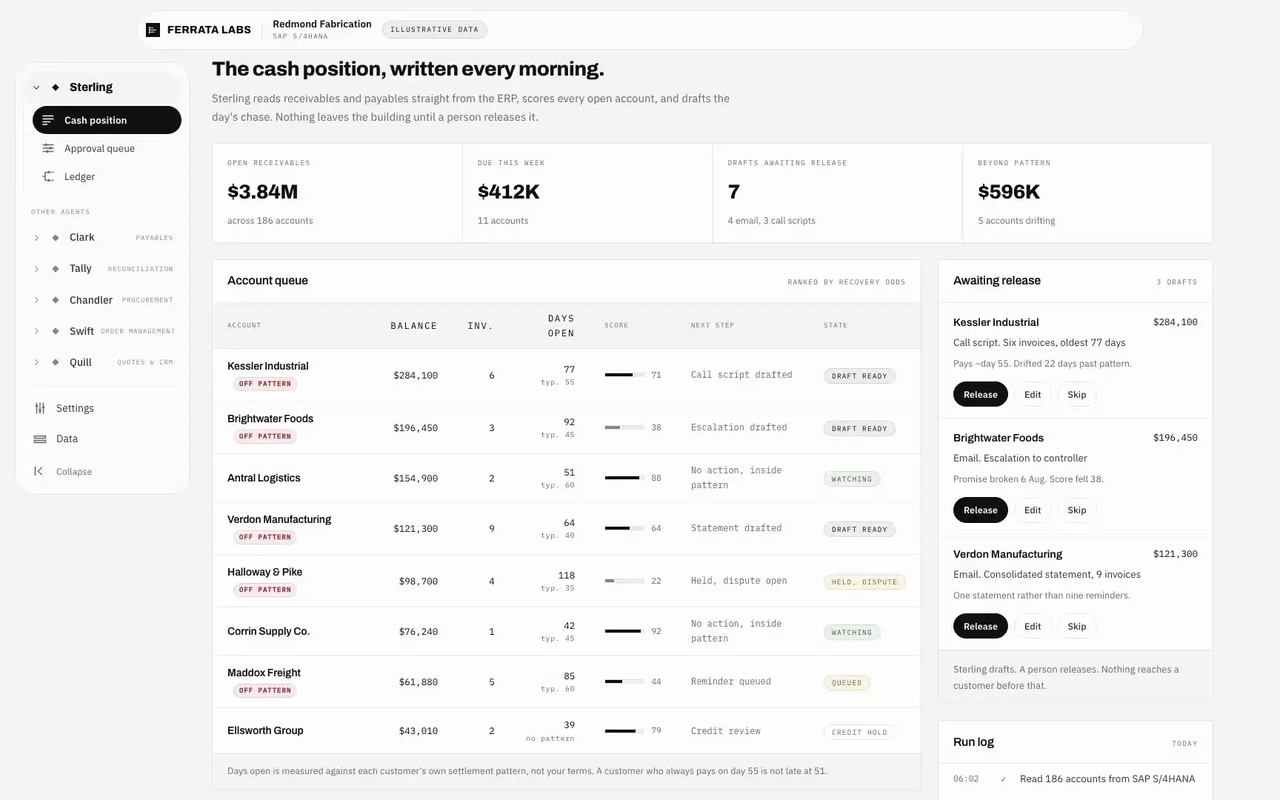
How Sterling does the work.
Reads receivables and payables from the ERP, narrates the cash position daily, and drafts collection sequences ranked by recovery odds.
- 01
Reads the ledger before anyone is awake
Pulls open receivables, payables and the bank position directly from SAP HANA, NetSuite or Dynamics. Not an export: a live read against the tables. Aging buckets are recomputed rather than trusted.
- 02
Scores every open account
Each account gets a recovery likelihood from payment history, current disputes, days beyond terms, recent contact and the size of the balance. A 90-day balance at a customer who always pays on day 95 is not the same problem as a 40-day balance at one who has gone quiet.
- 03
Writes the cash position in prose
A short daily note: what came in, what did not, what changed, and what it means for the week. Written, not charted, because a controller reads a paragraph faster than they read a dashboard.
- 04
Drafts the chase, in order
Collection sequences are drafted per account and sequenced by recovery odds, with the tone matched to the relationship and the history attached. Accounts in active dispute are suppressed automatically so nobody chases money that is already being argued about.
- 05
Tracks what was promised
Every promise-to-pay is recorded against a date. When the date passes without cash, the account re-enters the queue at the top with the broken promise in the context.
Where Sterling stops. Sterling drafts collection messages; it does not send them until a person releases the sequence. Nothing is written back to the customer master.
Your agents are built around your organization.
The way you price, route, approve and escalate is years of accumulated judgment, and it's a real advantage. It belongs to you and it stays with you, we're not asking you to hand over your playbook or fit yourself into someone else's template. We start from how your business already works, encode that logic into agents built for your environment, and leave you with an operation that runs faster with exactly the things that make you good at it still intact.
Bring us one workflow.
Thirty minutes, no deck. Pick the process that costs you most in people, errors or delay, and we'll pressure-test whether an agent is genuinely the right answer for it.
- An honest read on whether that workflow is a good agent candidate
- What the first deployment would involve, and roughly what it costs
- An honest answer if the sequencing is wrong and you should fix something else first