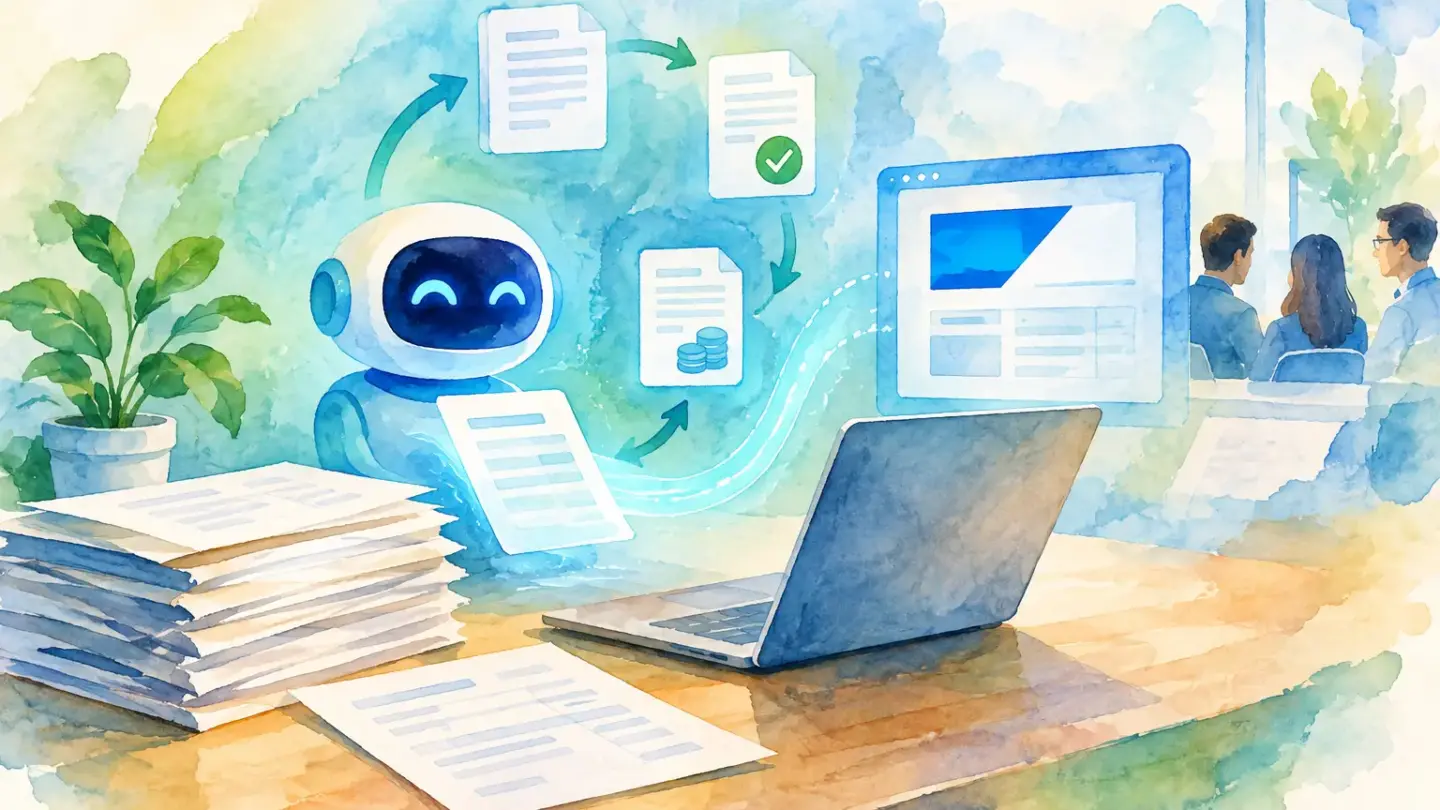
An invoice arrives without a purchase order, references a closed cost center, and carries a freight charge outside tolerance. Your AP team knows what to do. The problem is that the decision lives in inboxes, tribal knowledge, and a queue that grows faster than the team can clear it.
AI accounts payable automation SAP programs should address that execution gap. Not by adding a chat interface to AP, and not by launching another proof of concept that never touches a live posting. The objective is to put governed agents inside the workflow: reading documents, retrieving the relevant SAP data, applying approved policies, escalating exceptions, and taking only the actions they are authorized to take.
That distinction determines whether AI reduces AP cost and cycle time or simply gives the finance team another screen to monitor.
Key Takeaways
- AI accounts payable automation in SAP works when governed agents sit inside the live workflow, with SAP context and permission to take bounded actions, not as a chat layer on top of AP.
- Exceptions are where AP cost sits, because the last mile needs judgment that lives in inboxes and with senior processors.
- Authority should follow risk: low-risk repeatable exceptions may go straight through, medium-risk cases need AP lead approval, and high-value, new-supplier, bank-detail and tax cases stay behind stricter thresholds.
- Controls come before autonomy: a baseline, a runbook, an evaluation set from real AP cases, an audit trail, and defined escalation paths.
- Start with one exception stream, such as non-PO invoice triage or duplicate-payment prevention, and measure it against the baseline.
Why SAP AP automation stalls
AI accounts payable automation in SAP puts governed agents inside the AP workflow: they read invoices, retrieve the relevant SAP records, apply approved policies, escalate exceptions, and act only within authorized limits. It stalls when models get documents but not SAP context or permission to act, so exceptions stay manual and security teams block access.
Most accounts payable organizations already have automation. They use invoice capture, workflow routing, three-way matching, supplier portals, and SAP controls. Yet exceptions remain expensive because the last mile requires judgment: interpreting an invoice line, locating a receiving record, identifying a duplicate, or deciding whether a variance needs review.
Traditional automation handles the clean path well. It struggles when the document is incomplete, the reference data is inconsistent, or a business rule exists only in the head of a senior processor. Those are not edge cases in a transaction-heavy business. They are the daily operating reality.
AI can help, but many initiatives stop before they become operationally useful. Models are given documents but not the right SAP context. They can recommend an answer but cannot open a case, request a receipt confirmation, update a workflow status, or prepare a posting. Security teams block access because no one can explain what data the model used or what it is permitted to change. Finance leaders rightly refuse to let a probabilistic system post transactions without controls.
You bought AI. Nothing does the work.
The answer is not unrestricted autonomy. It is a production workflow with explicit boundaries.
What AI accounts payable automation in SAP should do
A useful AP agent operates within the systems and policy framework your team already uses. It does not require a disruptive ERP replacement. It connects to SAP data and workflow services with role-based permissions, then applies a defined sequence of retrieval, evaluation, action, and approval.
Consider a named agent such as Clark. Clark monitors invoices that fail standard matching and pulls the invoice image, purchase order, goods receipt, vendor history, payment status, relevant tolerance settings, and prior resolution patterns. It does not invent a policy. It evaluates the exception against the policies the company has approved.
For a price variance, Clark can identify whether the charge fits a known freight or commodity adjustment pattern, compare it with the PO and contract terms, and prepare a recommended disposition. For a missing receipt, it can identify the receiving owner, draft the request, create the follow-up task, and track the response. For a likely duplicate, it can compare vendor, amount, invoice number patterns, dates, banking references, and prior payment records before holding the invoice for review.
The work is valuable because it moves the transaction forward. A summary of the issue is not enough. The agent needs a permitted path to create the case, route the exception, draft the communication, update the audit record, and hand off a well-supported recommendation when human judgment is required.
The action boundary matters
Not every invoice should be treated the same. Low-risk, repeatable exceptions may be eligible for straight-through processing after the agent passes validation checks. Medium-risk cases may require an AP lead approval. High-value invoices, new suppliers, bank detail changes, tax anomalies, and policy overrides should remain behind stricter approval thresholds.
| Risk level | Typical cases | What the agent may do | Human control |
|---|---|---|---|
| Low risk | Low-risk, repeatable exceptions | Eligible for straight-through processing after validation checks | Sampling and monitoring after go-live |
| Medium risk | Cases needing a judgment call | Prepare evidence and a recommended disposition | AP lead approval |
| High risk | High-value invoices, new suppliers, bank detail changes, tax anomalies, policy overrides | Package the evidence and route to the approved owner | Stricter approval thresholds, with escalation if no response in the service window |
| Never without a designated approver | Changing bank details, releasing a payment hold | Nothing on its own | Designated approver acts |
This is where many AI claims collapse. An agent that can explain its answer is useful. An agent that can act within a controlled boundary is operationally valuable. An agent that can act, document its reasoning, retain source evidence, and escalate correctly is ready for finance production.
Build controls before increasing autonomy
SAP AP teams do not need a black box making payment-adjacent decisions. They need a controlled operating model that earns wider authority through evidence.
Start with a workflow baseline. Measure current invoice volume, touch rate, exception categories, days-to-approve, first-pass match rate, duplicate leakage, early-payment discount capture, and cost per invoice. Then identify one exception stream where the data is available, the work is frequent, and the business outcome can move within a reasonable period.
A good first use case might be non-PO invoice triage, blocked-invoice resolution, duplicate-payment prevention, or recurring price-variance review. The choice depends on where the operational friction sits. A business with weak receiving discipline should not begin by promising fully automated three-way matching. A company with high duplicate exposure may prioritize prevention and recovery ranking instead.
Before the agent sees live transactions, define the runbook. It should specify the data sources it can retrieve, the rules it can apply, the actions it can take, the approval thresholds, the escalation path, and the conditions that stop the workflow. It should also define what the agent must never do, such as changing bank details or releasing a payment hold without a designated approver.
Evaluation is not a one-time model test. Build an evaluation set from real historical AP cases, including clean invoices, common exceptions, and known failure modes. Test whether the agent retrieves the right SAP records, applies the right tolerance rule, cites the evidence correctly, and routes the case to the right person. Test failure behavior too. When data is missing or confidence is low, the correct result is often escalation, not a confident guess.
The architecture behind a governed AP agent
Production-grade AI accounts payable automation for SAP requires more than a model connection. The model is only one component in the system.
The agent needs retrieval connected to the relevant ERP records and supporting documents, not a broad dump of finance data. It needs model routing so lower-risk classification work can use an efficient model while complex document interpretation or policy reasoning uses the right capability. It needs permission controls tied to the user and service role. And it needs an audit trail that records the source evidence, rule or instruction applied, recommendation, action taken, approver, and final outcome.
Human approval controls must be native to the process, not a manual workaround. If an invoice exceeds a variance threshold, the agent should package the evidence and route it to the approved owner. If the owner does not respond within the defined service window, the workflow should escalate according to the operating model. That is how you avoid burying important exceptions in a shared mailbox.
The agent also needs monitoring after go-live. Track resolution accuracy, override rates, false duplicate flags, cycle time, exception backlog, and the percentage of cases resolved without an additional AP touch. If override rates climb, determine whether the issue is source data, an unclear policy, an evaluation gap, or a workflow rule that no longer matches the business. The fix is operational, not rhetorical.
What finance leaders should demand from an implementation
Do not accept a project plan built around demonstrations. Ask when the first agent will operate on live transactions, what SAP objects it will access, and which operating metric it is accountable for moving.
Demand named owners for business rules, access decisions, exception approvals, and change control. Require a clear answer on how the agent is evaluated before production and how its actions are logged afterward. Make sure your internal team receives the runbooks, evaluation scripts, integration knowledge, and operating controls needed to extend the capability without permanent vendor dependence.
Ferrata Labs approaches this work as an embedded implementation effort, not software theater. The aim is to deliver a first live agent within 90 days, establish measurable outcomes upfront, and leave the client equipped to build and operate future agents.
Start with the AP work your best processors resolve repeatedly but reluctantly: the cases that consume attention, delay close, and hide preventable leakage. Build the secured path around that work, prove the metric moves, and expand authority only as the controls and evidence justify it.
Frequently Asked Questions
What is AI accounts payable automation?
AI accounts payable automation in SAP uses governed agents inside the AP workflow. They read invoices and supporting documents, retrieve the relevant SAP records, apply approved policies, escalate exceptions, and take only authorized actions. It differs from a chat interface or recommendation screen because the agent can move the transaction forward within defined limits.
Does it require replacing SAP?
No, a useful AP agent works within the systems and policy framework your team already uses. It connects to SAP data and workflow services with role-based permissions, then applies a defined sequence of retrieval, evaluation, action, and approval. It does not require a disruptive ERP replacement.
What can an AP agent do beyond recommending an answer?
It can go beyond recommending an answer. With the right permissions, an agent can open a case, request a missing receipt confirmation, draft the communication, update a workflow status, prepare a posting, and record the evidence behind each step. A summary of the issue is not enough; the agent needs a permitted path to move the transaction forward.
Which invoices should still need human approval?
Match approval to risk. Low-risk, repeatable exceptions may be eligible for straight-through processing after validation checks. Medium-risk cases may need AP lead approval. High-value invoices, new suppliers, bank detail changes, tax anomalies, and policy overrides should stay behind stricter approval thresholds, which your team defines before go-live.
What is a good first use case?
Choose one exception stream where the data is available, the work is frequent, and the outcome can move in a reasonable period. Candidates include non-PO invoice triage, blocked-invoice resolution, duplicate-payment prevention, and recurring price-variance review. The right choice depends on where your operational friction sits and what your baseline shows.
How do you evaluate an AP agent before it goes live?
Build an evaluation set from real historical AP cases, including clean invoices, common exceptions, and known failure modes. Test whether the agent retrieves the right SAP records, applies the right tolerance rule, cites evidence correctly, and routes to the right person. Also test failure behavior: when data is missing or confidence is low, escalation is often the correct result.
What should finance leaders ask for from an implementation?
Ask when the first agent will run on live transactions, which SAP objects it will access, and which operating metric it is accountable for moving. Require named owners for business rules, access, exception approvals, and change control, plus the runbooks and evaluation scripts your team keeps after handover.
How long does it take to get a first AP agent live?
Ferrata Labs aims to deliver a first live agent within 90 days, with measurable outcomes agreed upfront and the runbooks, evaluation scripts, and integration knowledge handed to your team. Actual timing depends on SAP data access, the chosen exception stream, and how quickly business owners can set policy.